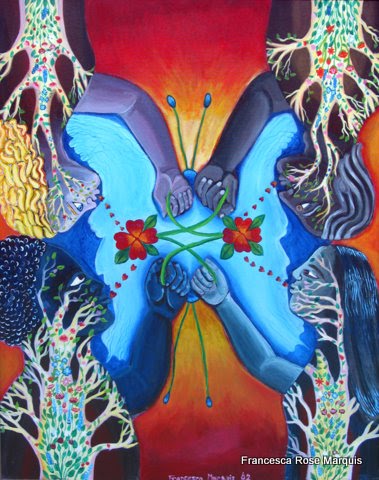


A letter to poetess Adrienne Rich
concerning her refusal of the National Medal for the Arts
July 3, 1997
“I believe in art’s social presence—as breaker of official silences, as voice for those
whose voices are disregarded, and as a human birthright...I have seen the space for the
arts opened by movements for social justice, (but) Over the past two decades I have
witnessed the increasingly brutal impact of racial and economic injustice in our
country...art means nothing if it simply decorates the dinner table of power which holds
it hostage. A President cannot meaningfully honor certain token artists while the
people at large are so dishonored.”- Adrienne Rich
Dear Adrienne Rich,
I am just one person affected by your words
and your ways.
This was not an act confined to letters.
You have caused me to think a great deal about art and justice:
What role does the U.S. government play?
It acts against
and in support of art,
just as artists support
and act against the U.S. government.
As for the times when artists have acted against the government to
verbally, physically, or literarily protest
the continued manufacturing and implementation of mines,
the increase in defense spending,
the recent immigration law which has forced thousands of potential
citizens from our country,
the exploitation and domination of developing countries,
the “don’t ask, don’t tell” sexual discrimination policy in the military,
all forms of racial, gender, and age discrimination, (due to protestation,
we now have laws protecting the people)
censorship, and any breach within the freedom of speech,
to name just a few.
Critics have asked
“should the government subsidize its own subversion?”
But subversion is the wrong word,
because it suggests conspiracy
sabotage, treason, destruction.
Your written and vocal work
and the act of sit-ins, strikes, picketing, questioning,
and refusing to be silent,
are not destructive;
they are enabling, enlivening, inspiring, encouraging.
Maybe these critics should instead be asking,
“should the government subsidize those who rebel,
who are defiant,
who resist,
who seek revolution?”
Yes, because as artists we seek to create
not destroy.
And because that is what a democracy stands for.
And still I understand why you did not accept this subsidy:
“When men suffer, they become politically radical;
When they cease to suffer, they favor the existing order.”
(Walter Prescott Webb, Plains Historian)
How then could you accept?
Do art and justice exist as one?
As united as music and poetry
as indivisible as freedom is from life,
as inseparable as life from blood,
as blood from the soil?
Or do art and justice
struggle alone,
aware of,
but estranged from the other?
Artists must not get too comfortable.
It is the hunger for growth and change
that keeps us aware and searching for something better.
Does the National Endowment for the Arts
simply provide much needed funds
for the most necessary of endeavors?
Though the NEA fosters the arts and indirectly supports
the causes they uphold and defend,
does it also create an artistic hierarchy
impenetrable by the working masses?
Who is upheld,
who is defended?
I do not know.
I can say that I believe artists are workers
in the spirit of community service,
as much as the nurses, the doctors,
the environmentalists, the teachers,
the welders, the farmers, the cooks, the feeders,
the scientists who seek the future,
as well as the craftswomen and craftsmen
who humbly cultivate their heritage.
As a service to this country,
it is also an artists’s right
to go against the precepts of tradition and heritage,
which can stifle and challenge creative and intellectual pursuits.
One such precept is to humbly accept the gifts we are given
and to graciously say ‘thank you.’
Some gifts are more difficult to accept…
You have showed me
that it is also an artist’s profound privilege and honoras
much as a congressperson or state representativeto
speak for those who would speak,
if only they could.
You have spoken for many.
I find as a young and hopeful writer
that it is my duty to listento
those who do speak and do make a difference.
Thank you for making me think.
Sincerely,
Elizabeth Dañiel Marquis

No comments:
Post a Comment